


| KEY TAKEAWAYS Weight is the best single indicator of quality. A table under 25kg will move around during play, a table over 50kg will not. Solid rods play better and last longer. Telescopic rods are the safer choice with young children. A full size table needs a room about 2.4m by 2.8m once you allow for players and rod travel. Home tables and commercial tables are built to different standards. Most home tables are not rated for pub or club use. |
Choosing a table football table comes down to three things: who is playing, how much room you have, and whether the table needs to survive a family, a pub, or a tournament. For most UK homes the sweet spot is a solid rod table of around 140cm long weighing 50kg or more, which stays still during play and takes years of use. For pubs, clubs and venues, a coin operated commercial table is the only sensible option.
Prices at SAM Leisure run from £99.95 for a tabletop model and up to £53,000 for a designer piece. This guide explains what changes as you move up in price, what size room you need, and which table suits which buyer. All prices are correct as of July 2026.
Five things separate a table you will still be playing on in ten years from one that ends up in the bin.
Weight is the most reliable quality signal there is. A light table rocks and slides when play gets competitive, and every knock loosens joints a little more. Our entry level Buffalo Winner weighs 22.6kg, which is fine for children playing gently. The Buffalo Big Brother weighs 73kg and does not move at all. The SAM Tempo Evo weighs a whopping 90kg because it is built for venues.
As a rule of thumb, look for 50kg or more if adults are going to play properly.
Cabinet material follows the same logic. Thin MDF is light and cheap and does the job on a children’s table. Phenolic board, solid wood and thicker laminates hold their shape better and take the punishment. Toulet builds the T11 around a 45mm wood structure, which is the sort of construction that survives decades in a home setting rather than seasons.
This is the decision that most affects how a table plays, and it is the one most buyers get wrong.
Solid rods run the full width of the table and stick out of the opposite side when you pull them. They give a better feel, they flex and return without staying bent, and they are what every serious player uses. The trade off is that a rod protruding out the other side is a genuine hazard around small children, and you need clear space at both sides of the table.
Telescopic rods are made in two parts, so the inner rod slides back inside the outer tube instead of poking out. They are the right answer with young children in the house, and they save space. They are not built for intensive use, so they are the wrong answer for a pub or commercial venue.
Rod diameter matters too. 16mm rods are stiffer and stronger than 13mm. The Buffalo Black Bandit II uses 16mm solid steel bars, and you can feel the difference against a thinner rod.

Plastic players are moulded onto the rod and are perfectly good for family play. Metal players, like the hand painted figures on the SAM futbolin range, hold their shape and give far more control. Some designs use players with two separate feet rather than a single moulded base, which lets you trap and roll the ball rather than just hit it.
The playfield surface controls speed. A flat printed surface plays predictably. The sloping playfield on the SAM futbolin tables keeps the ball moving and always in play for a faster, noisier game, which is exactly what you want in a busy venue.
Hollow plastic legs on a light cabinet are the weak point of most budget tables. Look for solid wood or steel legs, ideally with adjustable levellers on the feet. No table plays fairly if it sits on an uneven floor, and a levelling foot is the difference between a fair game and a ball that drifts to one corner every time.
This one is simple and it is worth saying plainly. Every Buffalo and Toulet table in our range is marked as not suitable for commercial use. That is not a hedge, it is a statement about the bearings, the rods and the cabinet. A table designed for a family playing at weekends will not survive a pub on a Saturday night.
If the table is going into a bar, a club, a staff room or a student union, buy a commercial SAM table. It can cost more upfront but it will still be working when the third home table would have been scrapped.
Most full-size tables are between 120cm and 150cm long. Here are the real dimensions of tables in our range, so you can measure against something concrete rather than a generic figure.
| Table | Overall size (L x W x H) | Playing surface | Weight |
| Buffalo Explorer (tabletop) | 94 x 51 x 31cm | 78.4 x 48.3cm | 10.3kg |
| Buffalo Shoot | 120 x 61 x 81cm | 105 x 58cm | 22.6kg |
| Buffalo Winner | 122 x 61 x 78cm | 103 x 57cm | 22.6kg |
| Buffalo Black Bandit II | 136.5 x 68 x 88cm | 118 x 62.5cm | 53kg |
| Buffalo Big Brother | 140 x 76 x 86cm | 119 x 67.9cm | 73kg |
| SAM Tempo Evo | 145 x 73cm | 115 x 70cm | 90kg |
The table itself is only half the calculation. Players stand at the two long sides, facing each other, and on a solid rod table the rods travel a long way out of the cabinet. Allow around 1m of clear space at each long side and about 50cm at each end.
For a 140cm table that means a floor area of roughly 2.4m by 2.8m, or about 8ft by 9ft. Telescopic rods reduce the side clearance you need, which is often the deciding factor in a smaller games room.
Ceiling height is rarely an issue, but if the table is going in a loft or a room with sloping ceilings, check that a standing adult has room to swing their arms freely.
There is no single right number, but there are clear bands, and each one buys you something specific.
| Budget | What you get | Right for |
| Under £200 | Light MDF cabinet, thin rods, plastic players, 10 to 25kg | Children up to about 12, occasional play |
| £500 to £700 | Heavier cabinet, 16mm solid steel rods, 50 to 75kg, integrated scorers | Family homes, adults playing properly |
| £3,500 to £5,000 | Commercial build, coin mechanism, metal players, steel legs, 90kg | Pubs, clubs, offices, serious home games rooms |
| £5,000 and up | Designer and specialist tables, custom finishes, restored vintage pieces | Statement pieces, hospitality, collectors |
Two honest points about that table.
First, there is a real gap in our range between about £650 and £3,500. That is not an oversight. Below £650 you are buying a home table, and above £3,500 you are buying a commercial machine built to take coins and daily abuse. There is not much genuine middle ground, and we would rather tell you that than push you towards something that does not exist. If the Big Brother at £650 is not enough table for you, the next real step up is a commercial one.
Second, the sub £200 tables are genuinely good at what they are for. The Buffalo Winner is designed for children up to about 12 and it does that job well. It just is not a table for four adults playing a tournament.
These are the tables we would point different buyers towards, and what each one is for.

At 94cm long and 10.3kg, the Buffalo Explorer sits on a dining table or a worktop and lifts off again. It has a 5mm MDF bed with a green veneer, slide through solid rods, and comes with two balls and two score counters. It is a tabletop football game rather than a football table, and priced accordingly.
The Buffalo Shoot is the one we recommend when there are small children in the house. The telescopic rods retract rather than protrude, which removes the main injury risk, and the wooden finish looks better in the living room than most tables at this price. It is 120cm long, 22.6kg, with 11 red and 11 blue players. Suitable up to about age 12, and not rated for commercial use.

The Black Bandit II is 53kg with chrome side bars for extra rigidity, 16mm solid steel rods, a 9.5mm bed and score counters built into the cabinet rather than bolted on. It also has cup holders, which sounds trivial until you have seen a pint go over a playfield. Not rated for commercial use.

If you want one table for a family of adults and older children, this is it. The Big Brother is 140 x 76cm with a 119 x 67.9cm playing surface and weighs 73kg, with slide through solid rods running on Buffalo bearings. It comes with four balls and manual scorers. It is the top of our home range and the last table before you move into commercial territory.

The SAM Tempo Evo is an all-weather commercial table. High resistance phenolic board, metal legs, anti slip levellers, aluminium players on solid rods, and an electronic coin acceptor with a large removable cash box. It weighs 90kg and holds up in conditions that would destroy a home table. Telescopic rods can be specified where younger players are involved, as can a free-play version.
The SAM Tecno is the Spanish futbolin design: a sloping playfield, a hard resin ball that stays in play, solid steel rods, and hand painted metal players with two feet each for proper ball control. It runs dual coin mechanisms, so you can set bonus pricing. This is the table we would put in a venue where people care about the football. The SAM Tecno was approved by the ITSF in 2018. The International Table Soccer Federation was set up in France in 2002 and is the sport’s governing body, so that approval means the table meets competition standards rather than just looking the part.
An optional glass holder fits to the end of the table, and telescopic rods and free play versions can be specified.
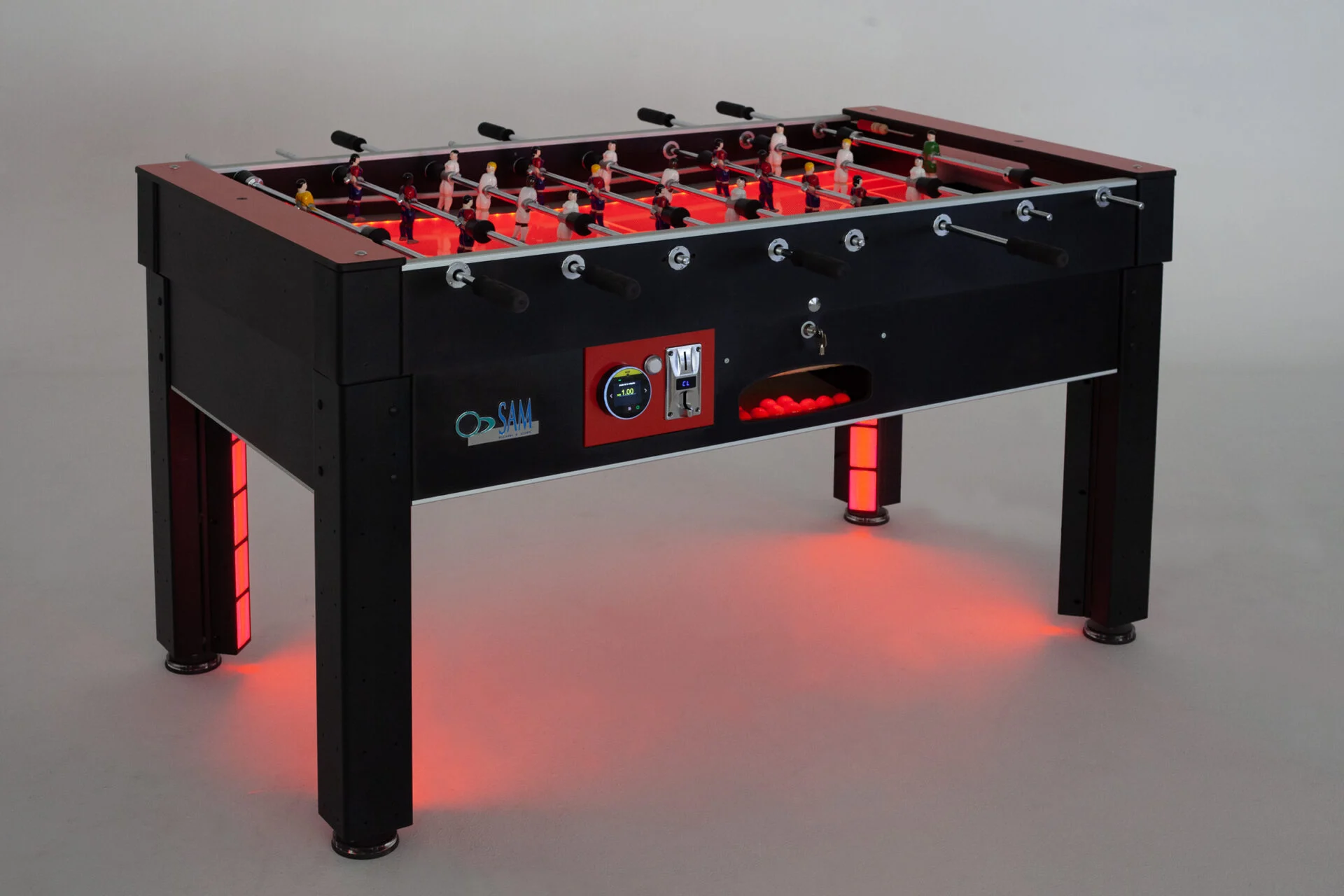
The Tecno Flame adds remote-controlled colour change lighting to the cabinet and the playing surface, and supports contactless payment as well as coins. The SAM Arena at £7,000 goes further, with RGB light sequencing, programmable goal music and electronic scoreboards at both ends.
Above that sit the Toulet football tables, made in France and numbered individually. The T11 at £5,600 uses a 45mm wood structure with 15mm chromed steel telescopic bars and lateral ball return. The Carat at £17,500 is built entirely from safety glass and works indoors or outside. The restored 1950s vintage table at £9,500 is rebuilt in the Toulet workshops using original parts.
Table top football is a genuinely good option in two situations: where there is no room for a full table, and where the players are young enough that a full size table would be too tall. The Buffalo Explorer covers both at £99.95. What you give up is stability, rod length and any sense of a proper game, so treat it as a game rather than a table.
Folding football tables are the other common shortcut. The idea is sound, but the hinge that lets it fold is also the weakest joint in the cabinet, and folding tables are usually the lightest tables in any range. We do not stock them, because in our experience they loosen up quickly and cannot be repaired properly once they do. If floor space is the problem, a tabletop model that lifts off and stores flat is the more durable answer.
This is where most buying guides stop, and it is worth covering properly, because the requirements are different.
A commercial table has to do three things a home table does not:
If you run a venue and want to see the difference before committing, we have some of our tables set up in our Coventry showroom, and volume pricing is available through our industry trade account.
Expert insight from Michael West, SAM Leisure
“The mistake I see most often is someone buying a home table for a space that’s really getting pub-level use, like a busy games room, a youth club, or a staff break room. It looks fine for the first few months, then the bearings and rods start to go because the table was never built for that volume of play. If more than a handful of people are going to be on it every week and you want it to last, it’s worth paying for a commercial build from day one.”
Almost no buying guide mentions this, and it is the thing that decides whether a table lasts.
Every table football table wears in the same places. Rod bearings tend to go first, then handles, then bumpers and stop rings, then the balls. On a good table those are all replaceable parts costing a few pounds each. On a cheap table they are moulded in, and when a bearing fails the table is finished.
Before buying, ask whether you can buy a replacement rod, a bearing and a handle for that specific table. We stock table football spares and accessories as individual parts, including 13mm and 16mm rods, bearings, players, handles, bumpers, score counters, balls and coin mechanisms. A set of ten tournament balls is £17.50, a rod bumper is £1.50, and a coin mechanism for a SAM table is £65.
A table you can repair for £20 every few years is cheaper over ten years than two tables you cannot repair at all.
Table football is low maintenance, but three habits make a real difference:
If you are putting together a wider games room, our games room ideas guide covers how to plan the space around a table, including lighting and clearance for a pool table alongside.
Browse the full range of table football tables, or look specifically at the SAM football tables if you need a commercial or coin operated machine.
If you would rather try before you buy, our Coventry showroom has tables set up to play on. Call us on 024 7646 1234 and we will tell you what is on the floor this week.
For children up to about 12, £165 to £200 buys a table that does the job. For adults playing properly at home, budget £500 to £700 for a table of 50kg or more with solid steel rods. For a pub, club or office, commercial tables start at around £3,500 and are the only option rated for that level of use. If you are a commercial business looking for a table, do enquire to see if you’re eligible for a trade account as well.
Most full-size tables are 120cm to 150cm long and 60cm to 76cm wide. Allow about 1m of clear space at each long side, where the players stand and the rods travel, and 50cm at each end. For a typical 140cm table that means a room area of roughly 2.4m by 2.8m.
Solid rods play better, last longer and are what serious players choose, but they protrude from the far side of the table and need clear space around it. Telescopic rods slide back into the cabinet, which is safer around young children and takes less room, but they are not built for intensive or commercial use.
None. They are two names for the same game. Table football is the usual British term, foosball comes from the German word for football and is standard in the United States, and futbolin is the Spanish name for the sloping playfield style of table. You will see all three used on product listings, including ours.
Table top models are a sensible choice where there is genuinely no room for a full table, or for younger children, and they store away between games. Folding tables are more of a compromise, because the folding hinge is the weakest point in the cabinet and cannot usually be repaired once it loosens.
Only if it is built for it. Standard MDF tables swell and fail outdoors within a season. The SAM Tempo Evo uses high resistance phenolic board on metal legs and is designed for outdoor and exposed sites, and the Toulet Carat is built from safety glass for indoor or outdoor use. Whatever the table, cover it when it is not in use.
On a good table, yes, and it is worth checking before you buy. Rods, bearings, handles, bumpers, players, score counters, balls and coin mechanisms are all replaceable parts on the tables we sell, with most spares costing between £1.50 and £20. On cheaper tables these components are often moulded in, so a failed bearing means a new table.
Michael West
Michael West is a pool and snooker equipment specialist with over 20 years of experience in the leisure industry. As part of the team at SAM Leisure, one of the UK’s leading pool table manufacturers and suppliers, he helps customers choose and maintain equipment for home and commercial use.