


| KEY TAKEAWAYS Bristle boards made from sisal are the standard for steel tip darts and league play. Electronic boards use soft tip darts, score automatically and are safer with children. The centre of the bullseye goes 1.73m from the floor, and you throw from 2.37m measured along the floor from the face of the board. A standard dartboard is 451mm across. Anything much smaller is a toy, not a board. The board is the cheap part. A cabinet, a surround, a mat and decent lighting cost more than the board and matter more to how the game feels. |
The best dartboard for home use depends on one decision: steel tip or soft tip. A bristle dartboard made from compressed sisal takes steel tip darts, plays exactly like the board in your local, and is what you want if anyone in the house plays properly. An electronic dartboard takes soft tip plastic darts, keeps score for you, offers dozens of games, and is the safer and quieter option in a family home.
Everything else follows from that. This guide covers both types, what separates a good board from a cheap one, the setup measurements that most people get wrong, and what else you need beyond the board itself. Prices in our range run from £36.95 for a bristle board to £224.95 for a tournament grade electronic board, correct as of September 2026.
| Bristle (steel tip) | Electronic (soft tip) | |
| Darts used | Steel tip | Plastic soft tip |
| Scoring | You do it | Automatic |
| Games | However many you know | 21 to 38 built in, depending on the board |
| Wall damage | Likely without a surround | Minimal |
| Noise | Quiet thud | Beeps and sound effects |
| Best for | League players, pub feel, serious practice | Families, children, casual play, groups |
| Our range | £36.95 | £42.95 to £224.95 |
If you play in a league, or you want to practise for one, buy a bristle board. Nothing else replicates the weight and rebound of a steel tip dart hitting sisal.
If the board is going in a family room, or younger children will use it, an electronic board is the more sensible buy. Soft tip darts do far less damage to walls, feet and furniture, and automatic scoring keeps a game moving when nobody wants to do mental arithmetic.
There is no rule against owning both, and plenty of people do.
A bristle dartboard is a block of compressed sisal fibre, a plant fibre grown mainly in East Africa, Brazil and China. When a dart goes in it parts the fibres rather than cutting them, and when the dart comes out the fibres close up again. That self healing is the whole point, and it is why a sisal board lasts years while a paper coiled board is finished in months.
Three things separate a good bristle board from a poor one.
The wire. Thinner wire means fewer bounce outs. The best boards use a thin blade style wire mounted flush to the surface, with no staples at the intersections. Older and cheaper boards use thicker round wire held by staples, and a dart landing on a staple bounces straight back out.
The numbering ring. A rotatable number ring lets you turn the board every week or two, so the 20 segment, which takes by far the most darts, moves to a fresh part of the board. This is the single biggest factor in how long a board lasts.
The sisal itself. Density and quality vary. A dense board takes a dart with a solid, quiet thud. A soft one lets darts sink too deep and pushes them back out.
Our bristle dartboard at £36.95 uses real sisal with metal edges and a rotatable numbering ring, and is 45.7cm across with a 3.8cm depth. It is set up for the standard English 20 point game.
On brands, the four names you will see most in UK league play are Winmau, Target, Shot! and Unicorn, and they all make excellent boards. Though we currently do not stock any of them, we are looking at adding them soon. What we do stock at the moment is a solid sisal board at a sensible price, plus everything that goes around it, which is where most home setups fall down.

Electronic boards vary far more in quality than bristle boards do, and the price differences are easy to understand once you know what to look at.
Segment count and misses. A board with a finer segment grid registers where the dart landed more accurately. Cheap boards miss darts that land near a wire, which is infuriating in a close game.
Number of players and games. An entry level board runs about 21 games. A mid range board runs 28 to 31 with over 150 level variations. A tournament grade board runs 38 games with more than 200 variants and supports up to 16 players, which matters if you host.
Display. Multiple LED displays let everyone see the score without walking to the board. Cricket scoring displays with the standard X and O marks are worth having if you play cricket at all.
Power. Battery operated boards are cheaper and can go anywhere. Mains adapter boards are brighter, louder and do not die halfway through a leg.
Cabinet quality. On a board that lives in a living room, the cabinet is what you look at when nobody is playing.
The bristle dartboard is the one to buy if you want a real board and you are happy to score by hand. Real sisal, metal edges, rotatable numbering, standard 45.7cm size.
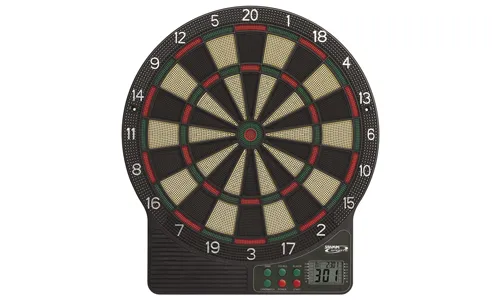
The battery operated electronic dartboard runs 21 different games with blunt plastic tip darts and keeps score automatically. It is the cheapest way to get a safe, self scoring board into a family room, and it does not need a socket nearby.

The Viper LED is the sweet spot for most homes. Twenty eight games with 167 level variations, three LED scoring displays including two dedicated cricket displays with the standard X and O marks, double in and double out options, and a computer opponent set at five difficulty levels so you can practise alone. Mains powered.
The Futura steps up to 31 games with 178 level variations, two LED displays with two cricket screens, and scoring for up to eight players. If darts is a regular fixture rather than an occasional one, this is the board that will not annoy you.
The Karella CB-90 runs 38 games with over 200 variants and supports up to 16 players, in a cabinet built to survive a busy room. If you run a club night, a works social or a big family, this is the one.
This is where most home setups go wrong, and it costs nothing to get right.
| Measurement | Metric | Imperial |
| Height, floor to centre of bullseye | 1.73m | 5ft 8in |
| Throwing distance, board face to oche | 2.37m | 7ft 9in |
| Standard board diameter | 451mm | 17.8in |
Three points people get wrong:
These are the measurements used across the game. If you want the background, the dartboard specification is well documented, and every board we sell is built to it.
The board is the cheapest part of a dartboard setup. Here is what makes the difference between a board nailed to a wall and something you are pleased with.
A cabinet. A cabinet protects the board from light and dust, gives you scoreboards on the inside of the doors, and closes up so the board is not the focal point of the room when nobody is playing. Our Kings Head cabinet is £49.95 and measures 51.5 x 64 x 8.5cm.
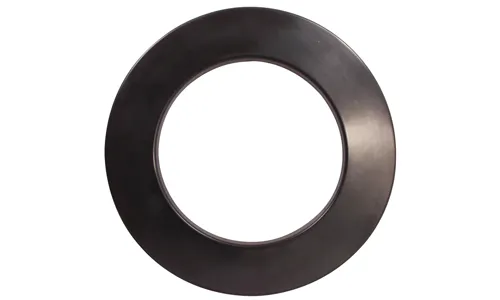
A surround. A dartboard surround, sometimes called a catchring, is a rubber ring that sits around the board and catches everything that misses. Without one you will put holes in the wall, and you will do it in the first week. Ours is £45.95 in plain black or £44.95 in a sectional design, which is easier to replace one piece at a time as it wears.
A mat. A dart mat protects the floor, protects the points on your darts when they drop, and marks the oche for you so nobody has to argue about where to stand. The Karella Eco Star mat at £49.95 carries the 237cm distance marking and is made from an odourless resin rather than rubber. The rubber oche mat at £79.95 is 330 x 60cm with a raised yellow oche bar your foot cannot slide over, and can be cut to length.
Scoring. If you are on a bristle board and want to keep the pace up without doing the maths, the Game On dart counter at £320 handles it electronically while you keep the steel tip board.
Lighting. The most common complaint about a home board is shadow. A dart thrown from 2.37m casts a shadow across the board if the light is behind you. Light the board from above and slightly in front, or fit a purpose made dartboard light. If you are planning a whole room, our games room ideas guide covers lighting for cue sports and darts together.
Less than most people assume. You need:
A hallway, a garage, a loft or the end of a games room all work. What does not work is a spot where the throwing line crosses a doorway, for reasons that become obvious the first time somebody walks through.
Expert insight from Michael West, SAM Leisure
“Darts tend to be the thing people add once they’ve already sorted a pool or snooker table, rather than the starting point. It’s usually the cheapest part of a games room, but it doesn’t need to be an afterthought. A board, a surround and a mat, set up properly, make as much difference to a room as a focal point games table does.”
A bristle board that is looked after lasts years. One that is not is finished in months.
Browse the full darts range for boards, cabinets, surrounds, mats, steel dart sets, soft tips and flights.
Work out first whether you want steel tip or soft tip, then buy the board, a surround and a mat together. Those three are what make a home setup feel finished.
Browse the full darts range, or call us on 024 7646 1234 if you want a hand working out what fits your space. Our Coventry showroom is also set up if you would rather see things in person.
The centre of the bullseye should be 1.73m, or 5ft 8in, from the floor. That height is the same for everyone, adults and children. Measure to the centre of the bull, not to the top or bottom edge of the board.
The throwing distance is 2.37m, or 7ft 9in, measured horizontally along the floor from the face of the board to the oche. Measure from the board face rather than the wall, because a board in a cabinet sits several centimetres proud of the wall.
Bristle is better if anyone plays in a league or wants to practise properly, because steel tip darts on sisal are what the game is played on everywhere else. Electronic is better for families, younger children and casual group play, because soft tip darts are safer, the board scores for you and it offers dozens of built in games.
A surround, or catchring, is a rubber ring fitted around the board to catch darts that miss. You need one. Without it, stray darts go into the wall, and a surround costs less than making good the plaster afterwards.
For very young children, yes, as a safe introduction to the scoring and the numbers. For anyone else, no. Magnetic darts do not fly like real darts, they fall off the board on a good throw, and the board teaches you nothing about aim or weight. Buy a soft tip electronic board instead if safety is the concern.
A quality sisal board in regular home use lasts several years if you rotate the numbering ring every week or two and keep it dry. Without rotating, the 20 segment wears out first and the board is finished far sooner. Electronic boards are limited by their segment membranes, which last many years of home use.
A standard dartboard is 451mm, or about 17.8in, across. Boards sold as smaller than this are novelty or children’s boards, and darts thrown at them do not translate to a standard board.
Michael West
Michael West is a pool and snooker equipment specialist with over 20 years of experience in the leisure industry. As part of the team at SAM Leisure, one of the UK’s leading pool table manufacturers and suppliers, he helps customers choose and maintain equipment for home and commercial use.